Background
Non-alcoholic fatty liver disease (NAFLD) is one of the most common chronic liver diseases worldwide and is closely associated with:
- Obesity
- Insulin resistance
- Type 2 diabetes
- Dyslipidemia
- Metabolic syndrome
Oxidative stress plays a major role in the progression of NAFLD to inflammation (NASH) and fibrosis. Since N-acetylcysteine (NAC) replenishes intracellular glutathione, a major antioxidant, researchers investigated whether it could improve liver function.
Objective
To determine whether oral NAC improves liver function in patients with NAFLD.
Study Design
- Type: Prospective randomized clinical trial
- Duration: 3 months
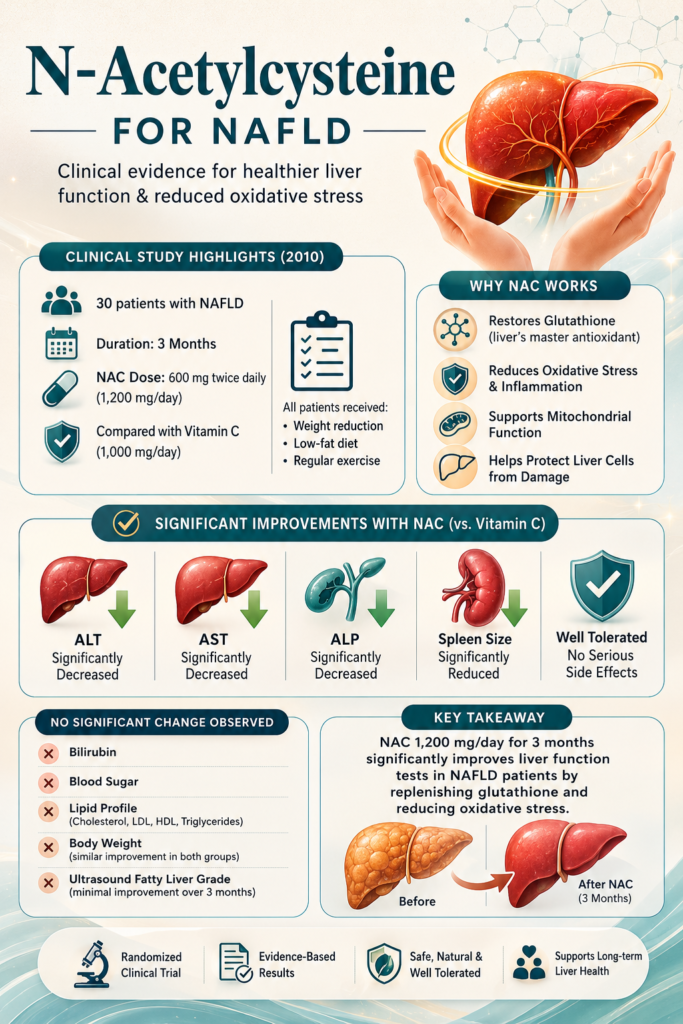
- Participants: 30 patients with confirmed NAFLD
- Diagnosis: Elevated liver enzymes and ultrasound evidence of fatty liver
- Patients were randomly divided into two groups.
Intervention Group
- NAC: 600 mg twice daily
- Total daily dose: 1,200 mg/day
Control Group
- Vitamin C: 1,000 mg/day
Both groups received:
- Advice on weight reduction
- Low-fat diet
- Regular exercise
Parameters Measured
Researchers evaluated before and after treatment:
- Alanine aminotransferase (ALT)
- Aspartate aminotransferase (AST)
- Alkaline phosphatase (ALP)
- Total bilirubin
- Lipid profile
- Fasting blood sugar
- Body weight
- Spleen size (ultrasound)
- Liver ultrasound findings
Results
1. ALT (Primary Liver Enzyme)
NAC produced a significant reduction in ALT.
- Improvement was significantly greater than Vitamin C.
- Indicates reduced liver cell injury.
2. AST
AST also decreased significantly in the NAC group.
Again, improvement exceeded that seen with Vitamin C.
3. ALP
ALP decreased significantly with NAC treatment.
4. Spleen Size
One interesting finding was:
Patients receiving NAC experienced a significant reduction in spleen size, suggesting possible improvement in portal congestion or liver inflammation.
5. Bilirubin
No significant changes.
6. Blood Sugar
No significant improvement.
7. Lipid Profile
No significant changes in:
- Total cholesterol
- LDL
- HDL
- Triglycerides
8. Body Weight
Weight loss occurred in both groups because all patients received dietary and exercise advice.
The difference between groups was not significant, indicating that NAC’s liver benefits were unlikely to be explained simply by greater weight loss.
9. Ultrasound Fatty Liver Grade
Ultrasound appearance showed only minimal improvement during the 3-month study.
Researchers note that structural liver changes usually require longer treatment than biochemical improvements.
Why NAC May Work
The paper discusses several mechanisms:
Restores Glutathione
NAC is the direct precursor of glutathione, the liver’s principal intracellular antioxidant.
Reduces Oxidative Stress
Oxidative stress contributes to:
- Lipid peroxidation
- Hepatocyte injury
- Inflammation
NAC reduces reactive oxygen species by restoring antioxidant defenses.
Improves Mitochondrial Function
By preserving glutathione stores, NAC may improve mitochondrial function and reduce oxidative injury.
Reduces Inflammatory Damage
Lower oxidative stress may reduce inflammatory signaling involved in progression from fatty liver to steatohepatitis.
Safety
- NAC was generally well tolerated.
- No serious adverse effects were reported.
- Compliance was good.
Authors’ Conclusions
The authors concluded that:
- Oral NAC 600 mg twice daily for 3 months significantly improved liver function tests in patients with NAFLD.
- ALT, AST, ALP, and spleen size improved more than with Vitamin C.
- Improvements in liver enzymes occurred without significant changes in blood sugar, lipid profile, or body weight.
- NAC may help protect the liver by replenishing glutathione and reducing oxidative stress.
- Longer treatment durations may produce greater improvements in liver structure and ultrasound findings.
Key Takeaways
| Parameter | Effect of NAC |
|---|---|
| Dose | 600 mg twice daily (1,200 mg/day) |
| Study duration | 3 months |
| ALT | Significantly decreased |
| AST | Significantly decreased |
| ALP | Significantly decreased |
| Bilirubin | No significant change |
| Blood glucose | No significant change |
| Lipid profile | No significant change |
| Body weight | No significant difference vs. control |
| Spleen size | Significantly reduced |
| Ultrasound fatty liver | Minimal improvement over 3 months |
| Safety | Well tolerated, no serious adverse events |
Overall conclusion
This randomized clinical trial provides evidence that 1,200 mg/day of NAC for 3 months improves biochemical markers of liver injury in patients with NAFLD, likely through its antioxidant effects and restoration of glutathione. The authors suggest that longer treatment may be needed to produce meaningful improvements in liver fat and structural changes visible on ultrasound.