
How to Eat Rice with DiabetesWithout Spiking Your Blood Sugar
8 min read • Evidence-based tips • Type 2 Diabetes friendly
A traditional Indian thali reinvented for diabetes management
| THE KEY INSIGHT Rice has a high glycemic index — but the way you eat it matters just as much as how much you eat. With the right technique, portion, and pairing, you can still enjoy rice while keeping your glucose levels in check. |
Rice is a staple food across India. Giving it up completely is not only unrealistic — it may be unnecessary. The problem isn’t rice itself. The problem is eating it in a way that overwhelms your body’s glucose response.
Why rice raises blood sugar so fast
When you eat plain rice on its own — especially in a soft, well-cooked form — it is essentially pre-digested starch. Your gut absorbs it rapidly, flooding the bloodstream with glucose within 30–45 minutes. The result: a sharp glucose spike followed by a crash that leaves you hungry again soon after.
| Food | GI Score | Impact |
| Plain white rice (alone) | 72–80 | HIGH ★★★ |
| Rice + dal + salad | ~45–55 | MODERATE ★★ |
| Rice + salad + lemon + fat | ~38–48 | LOWER ★ |
GI values are estimates. Individual responses vary.
The method: mix, chew, and slow down
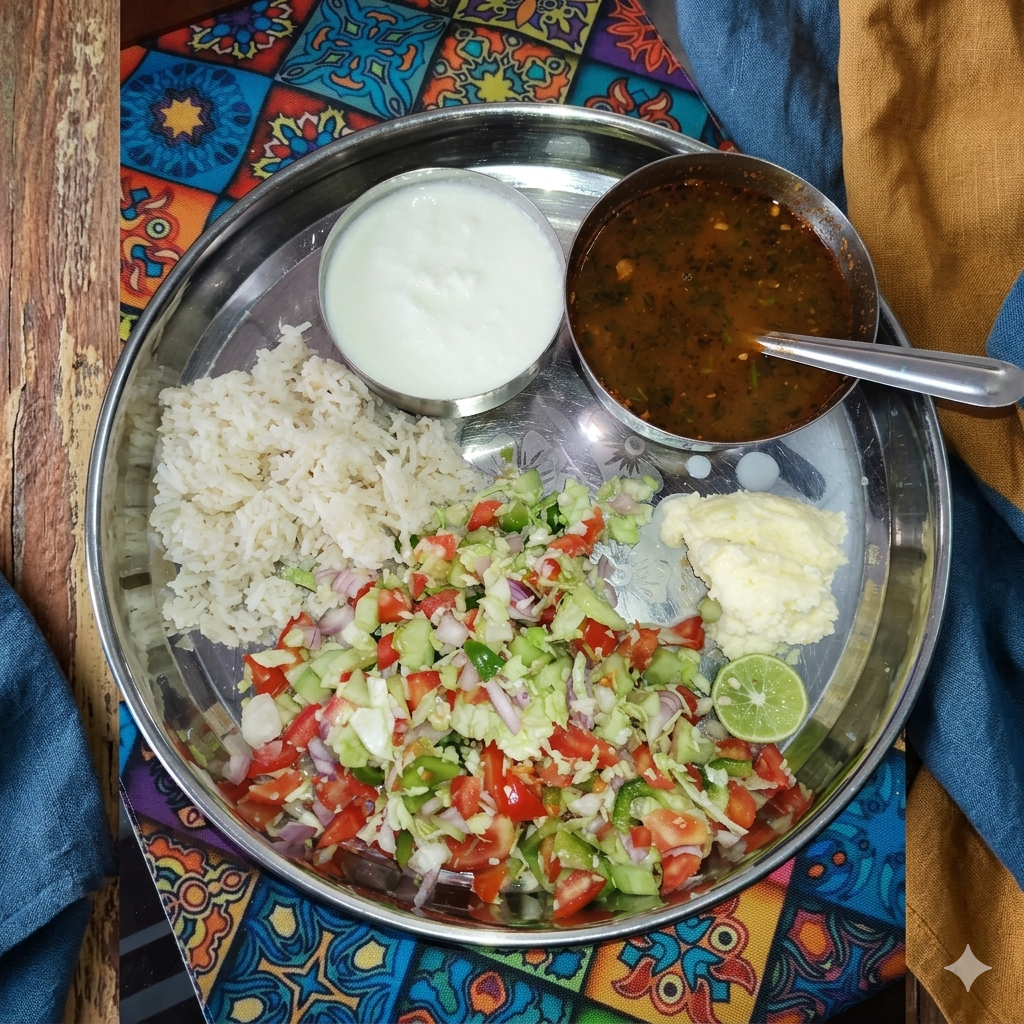
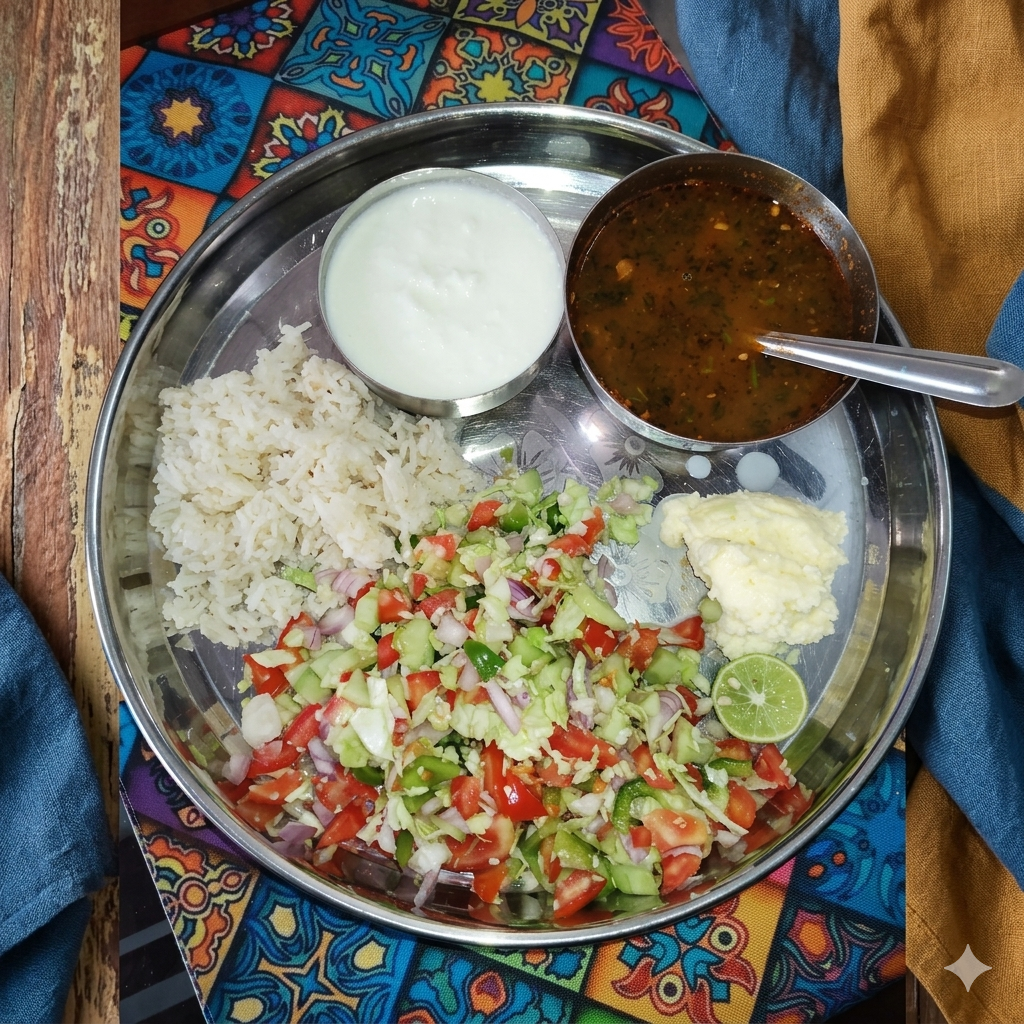
The thali shown above is a practical example of this approach. It includes rice, a fresh kachumber salad (tomato, cucumber, onion, capsicum, coriander), a squeeze of lemon, a small amount of butter, curd, and dal — all on a single plate.
| Component | Item | Role |
| Base | Rice (controlled portion) | Carbohydrate source |
| Volume & Fibre | Kachumber salad | Slows digestion, forces chewing |
| Acid | Lemon juice | Lowers GI via enzyme inhibition |
| Fat | Butter / white butter | Slows gastric emptying |
| Protein | Curd (dahi) | Blunts glucose spike |
| Protein + Carbs | Dal | Slow-release energy |
Why mixing rice with salad works
When you mix raw, chopped salad into your rice, several powerful things happen simultaneously:
- You chew more. Raw vegetables are fibrous. You cannot swallow a mouthful of salad-rice the way you can plain rice. More chewing means slower eating — and that is crucial for blood sugar.
- The fibre from the salad slows digestion. Insoluble and soluble fibre forms a gel-like matrix in the gut that physically slows how fast glucose enters your bloodstream. It changes a highway into a country road for glucose.
- Lemon juice lowers the GI. This is measurable, not folklore. Citric acid slows the enzyme activity that breaks down starch. Studies show that adding acid to a starchy meal can reduce its glycemic response by 20–35%.
- A small amount of fat (butter) further slows absorption. Fat delays gastric emptying — meaning food moves more slowly from your stomach into the small intestine, blunting the glucose curve.
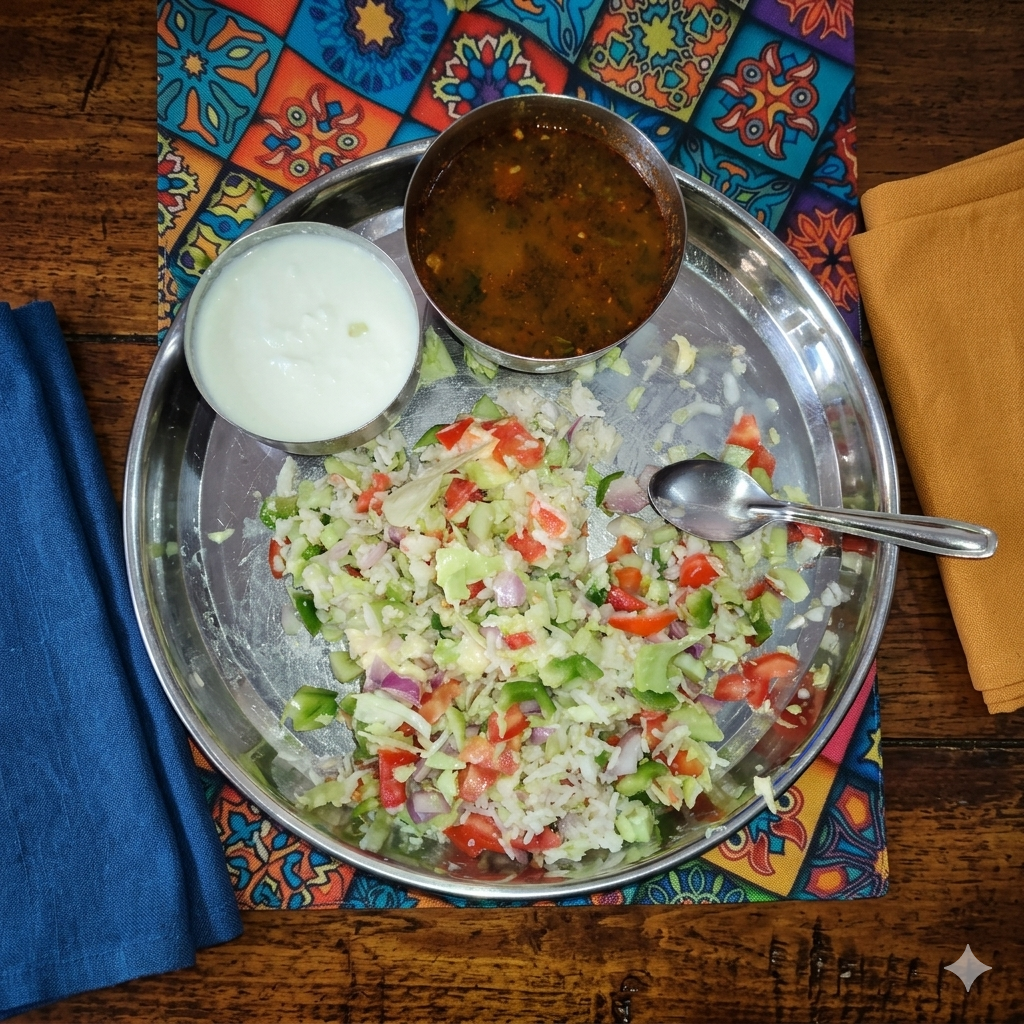
- You eat more slowly overall. The texture contrast — soft rice, crunchy salad — means you cannot rush this meal. Once mixed (as in the second photo), you take smaller, more varied bites naturally.
| THE SCIENCE: SATIETY SIGNALS Fullness after a meal comes from two main sources — stretch receptors in the stomach wall that respond to physical volume, and hormonal signals (like GLP-1 and PYY) that take about 15–20 minutes to reach the brain after eating begins. A meal that takes 20+ minutes to eat ensures your brain receives the satiety signal before you have overeaten. Chewing-intensive, high-volume meals with raw vegetables achieve this naturally, without willpower. |
The 20-minute meal principle
This thali — with its large salad volume mixed into the rice — takes roughly 20 minutes to eat at a comfortable pace. That is the exact window science tells us is needed for satiety hormones to kick in.
| 0 min Start eating | 5 min Stomach stretch receptors begin firing | 12 min GLP-1 hormones rise | 20 min Brain receives fullness signal |
If you eat a bowl of plain rice in 5 minutes (very easy to do), you bypass this entire system. You have already eaten too much before your brain knows it. By mixing rice with a large, fibrous salad, you force the meal duration to match your biology.
Portion guidance
The photos show approximately the right proportion: rice occupies about one-third of the thali, with salad occupying nearly half the plate. The salad is not a side — it is the main volume of the meal.
| PORTION TIP For most adults with type 2 diabetes: aim for 1/2 to 3/4 cup of cooked rice per meal, mixed into at least 1.5 to 2 cups of raw salad. Add dal or curd for protein. This meal, as shown, is a well-balanced diabetic-friendly plate. |
What about the texture?
One underappreciated benefit of this method: when rice is mixed thoroughly into the salad (as shown in the second photo), its texture changes. Each grain gets coated in lemon juice, vegetable moisture, and a little fat. The eating experience changes — you no longer get the smooth, gulpable quality of plain rice. Every bite has crunch. Every bite needs chewing. This textural shift is functional, not just aesthetic.
Key takeaways
| Control portion, not just intake Keep rice to 1/2–3/4 cup. Increase salad volume to compensate. | Add acid (lemon) Citric acid measurably lowers the glycemic response of starch. |
| Mix, don’t separate Mixing forces slower eating, more chewing, and better texture variation. | Allow 20 minutes Satiety signals need time. A crunchy, mixed meal gives it to them. |
| Include protein and fat Dal, curd, and a small amount of butter slow glucose absorption. | Eat mindfully No screens, no rushing. Let your stomach and brain sync up. |
Medical disclaimer: This article is for general informational purposes and does not constitute medical advice. If you have diabetes, always consult your doctor or a registered dietitian before making significant changes to your diet. Blood sugar responses to food vary between individuals.